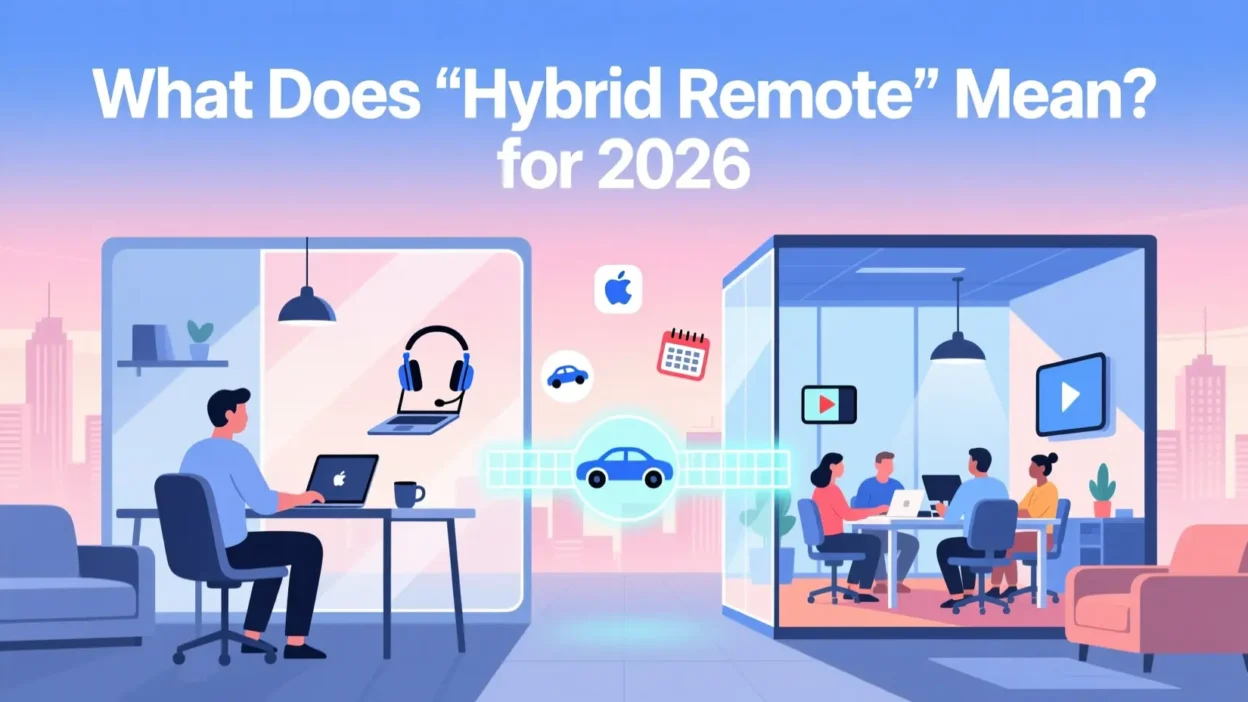
You’ve probably seen a job post or message that said something like, “This role is hybrid remote” — and if you paused for a second wondering “Wait… so am I working from home or going to the office?” you’re not alone. The first time I saw it, I thought it was a fancy way of saying remote, but nope — it’s a very specific kind of work setup.
To save you from the same confusion, here’s the quick meaning:
Quick Answer: Hybrid remote means a job where you work partly from home and partly in the office. It’s a flexible, semi-remote work arrangement based on your company’s schedule or your own choice.
Let’s break it down in simple, easy-to-use, text-slang style.
🧠 What Does “Hybrid Remote” Mean in Text?
When someone says “hybrid remote” in a message, job description, or email, they mean:
👉 You work some days remotely (from home) and some days onsite (in the office).
It’s a mix of remote work + in-office work — hence the word hybrid.
Example
“The role is hybrid remote — usually 2 days in office and 3 days from home.”
In short: “Hybrid remote” = partly work-from-home + partly office work = flexible work setup.
📱 Where Is “Hybrid Remote” Commonly Used?
You’ll see hybrid remote most often in:
- 💼 Job descriptions
- 📨 Professional emails
- 👥 HR or recruiter chats
- 🗂 LinkedIn posts
- 📊 Team discussions or schedule planning
Tone:
✔ Formal
✔ Professional
✔ Clear and straightforward
✖ Not slangy or casual
✖ Not used in flirty/friendly texting
💬 Examples of “Hybrid Remote” in Conversation
Here are realistic chat-style examples:
1.
A: is this job fully remote?
B: not fully — it’s hybrid remote, 3 days wfh.
2.
A: what’s the work setup?
B: hybrid remote. we go in mon & wed.
3.
A: can i choose my own days?
B: yup, it’s flexible hybrid remote.
4.
A: are you in office today?
B: nope, hybrid remote. today’s my home day 😌
5.
A: i thought u worked remote?
B: technically hybrid remote lol
6.
A: so ur team meets every week?
B: yeah, hybrid remote means we have 1 office day.
7.
A: can we do the meeting online?
B: sure, hybrid remote ppl can join virtually.
🕓 When to Use and When Not to Use “Hybrid Remote”
✅ Use “Hybrid Remote” When:
- Describing a job’s work arrangement
- Talking to recruiters or HR
- Explaining your work schedule
- Writing professional emails
- Posting on LinkedIn
❌ Don’t Use “Hybrid Remote” When:
- Chatting casually with friends (unless it’s about work)
- Sending flirty or personal messages
- Writing formal documents unrelated to work schedules
- Talking about something that’s not job-related
🔍 Comparison Table
| Context | Example Phrase | Why It Works |
| Friend Chat | “i’m hybrid remote so i only go in twice” | Casual but informative |
| Work Chat | “This position is hybrid remote.” | Clear & professional |
| “Our team follows a hybrid remote model.” | Formal, concise, business-appropriate |
🔄 Similar Slang Words or Alternatives
| Term / Slang | Meaning | When to Use |
| Remote | Fully work-from-home | When there’s zero office requirement |
| WFH | Working from home | Casual chats or team messages |
| Onsite | Full-time in-office | When office presence is required daily |
| Flexible schedule | Choose your hours or days | When schedule freedom is the focus |
| Hybrid model | Any mix of in-office + remote | Broad explanation in professional settings |
❓ FAQs About “Hybrid Remote”
1. Does hybrid remote mean I must go to the office?
Yes — hybrid means both remote and in-office work.
2. How many days do hybrid remote jobs require in-office?
It depends on the company — often 1–3 days per week.
3. Can hybrid remote be fully flexible?
Some companies let you pick your days, others assign them.
4. Is hybrid remote considered “remote work”?
Partially. It’s semi-remote, not fully remote.
5. Is “hybrid remote” formal?
Yes — it’s a professional term used in work environments.
Conclusion
In 2026, “hybrid remote” has become more than just a buzzword—it’s the new standard for how modern teams operate. It blends the structure of in-office work with the freedom of remote flexibility, giving employees the best of both worlds. Whether a company follows a set schedule (like 3 days in-office and 2 remote), a flexible approach where teams choose their own rhythm, or a fully distributed system with optional workspaces, hybrid work empowers people to perform at their best while maintaining balance.